Do cats like music? What the research found, and what to play for yours
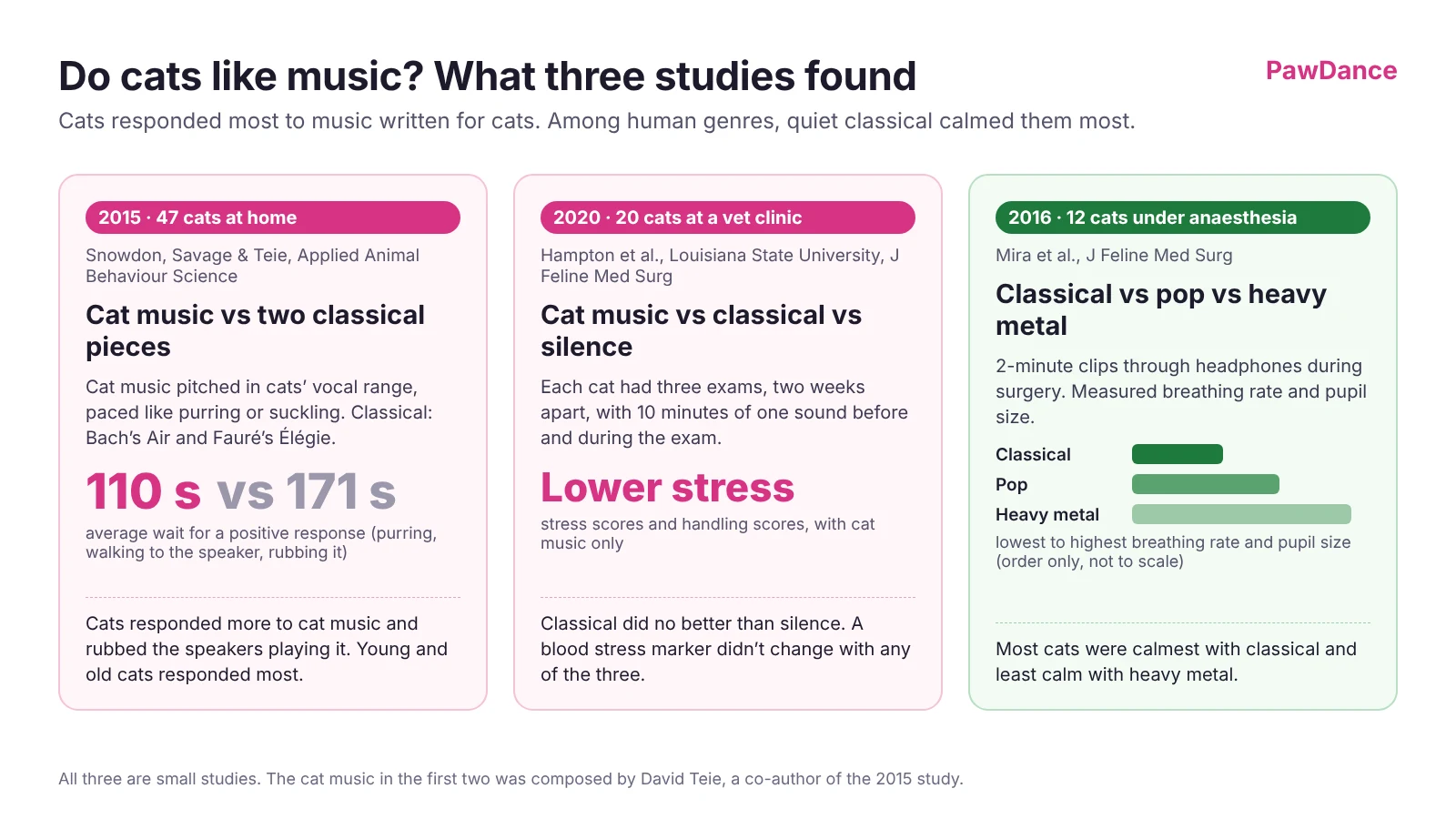
Most cats ignore human music. In studies, cats responded faster to music written for cats, pitched in their own vocal range and paced like purring or suckling, and were calmer at the vet while it played. Among human genres, quiet classical calmed cats under anaesthesia most and heavy metal least. Play it softly and let your cat decide.
So, do cats like music? Some do, a little, and mostly not the kind you would put on. If your cat has ever slept through your favourite album and then sprinted out of the room at the sound of a crisp packet, you already know that cats judge sound by their own rules. Below is what three studies actually measured, why most human songs miss cats, what music cats like when they have a choice, and a simple way to test it on your own cat. We make AI pet dance videos, so at the end we also look at our own cat videos and whether the cats in them like the music. (They never heard it.)
What the research says about cats and music
Three studies come up again and again on this question. The figure at the top of this page sums them up.
Cats pay attention to music made for cats
In 2015, psychologists Charles Snowdon and Megan Savage worked with composer David Teie to write music for cats. It sat in the frequency range of cat calls, about an octave or more above human voices, with lots of sliding notes, and was paced like purring in one piece and like a kitten suckling in another. They played it to 47 cats in their own homes, alongside two classical pieces, Bach’s Air on the G String and Fauré’s Élégie. According to the University of Wisconsin–Madison’s summary of the study, cats showed positive responses (purring, walking to the speaker, rubbing against it) after 110 seconds on average for cat music and 171 seconds for the classical pieces. Cats rubbed the speakers playing cat music, which the researchers read as claiming them. Young and old cats responded more than middle-aged ones.
Cat music lowered stress at the vet
A team at Louisiana State University tested the same idea where cats need it most: the exam table. Twenty cats each had three check-ups, two weeks apart, with 10 minutes of silence, Fauré’s Élégie or Teie’s “Scooter Bere’s Aria” before and during the exam. In the published paper (Hampton et al., Journal of Feline Medicine and Surgery, 2020), cats had lower stress scores and were easier to handle with cat music than with silence or classical. Classical did no better than silence. A blood marker of stress didn’t change in any of the three conditions, which the authors put down to the short session.
Under anaesthesia, classical beat pop and heavy metal
Another team played 2-minute clips through headphones to 12 cats during spay surgery and measured their breathing rate and pupil size. Most cats had the lowest values with classical music, middling with pop, and the highest with heavy metal (Mira et al., Journal of Feline Medicine and Surgery, 2016). These cats were asleep, which may be the only way most cats will sit through a heavy metal set.
What these studies can’t tell you
With 47, 20 and 12 cats, all three studies are small, so treat the results as hints. The cat music in the first two came from one composer, David Teie, who also co-wrote the 2015 paper, and neither study tried anyone else’s. And none of them tested a cat left home alone, all day, at a set volume: every session was short and supervised.
Why most human music doesn’t reach cats
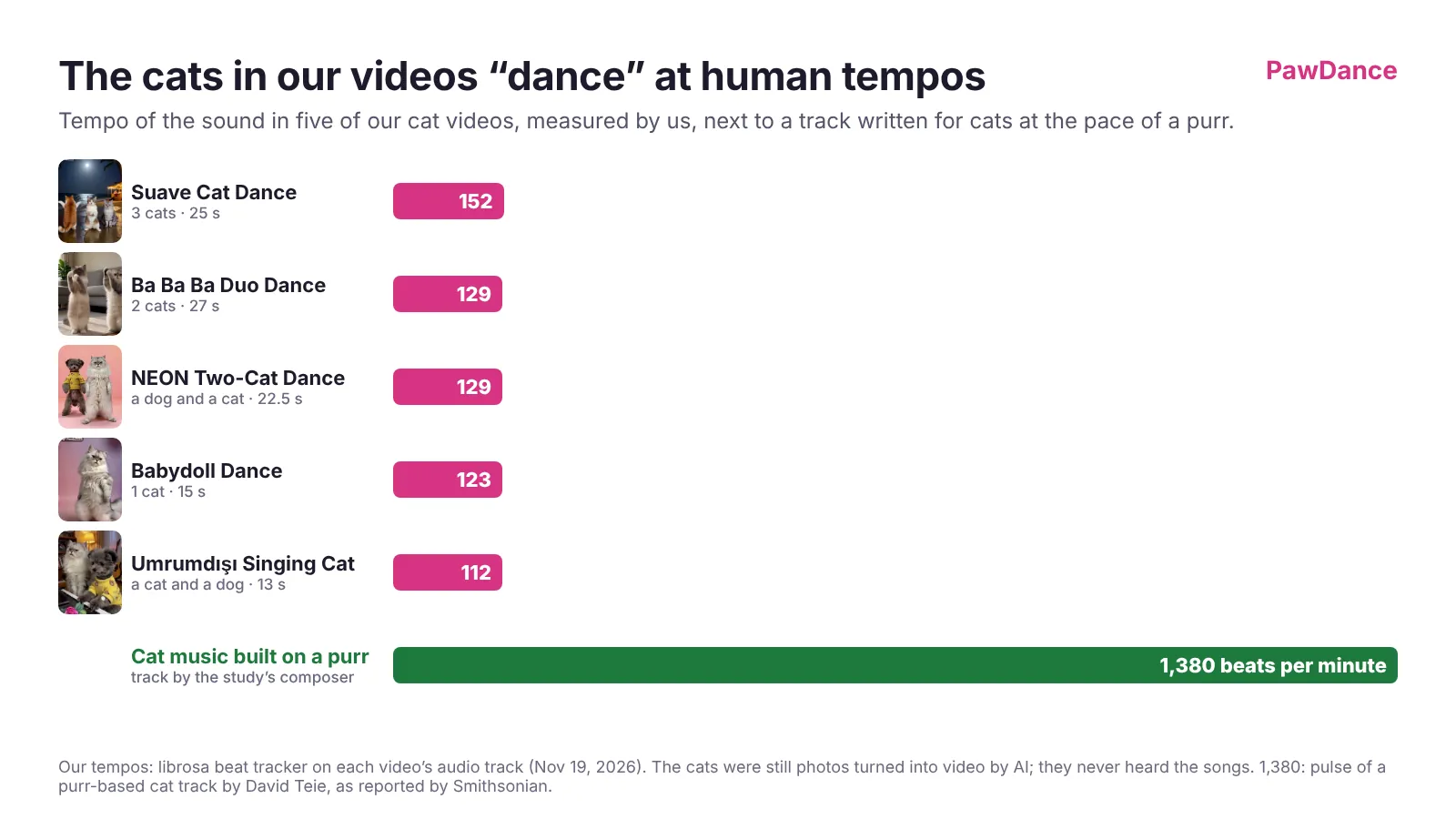
According to the researchers, music works on an animal when it sits in the pitch range and tempo that animal uses to communicate. Human songs are built around human voices and human tempos. Cat calls are higher, and purring has a pulse far faster than any drumbeat. One of Teie’s purr-based tracks has a pulse of 1,380 beats per minute, Smithsonian reported. The pop songs in our own cat videos, measured further down, run at 112 to 152.
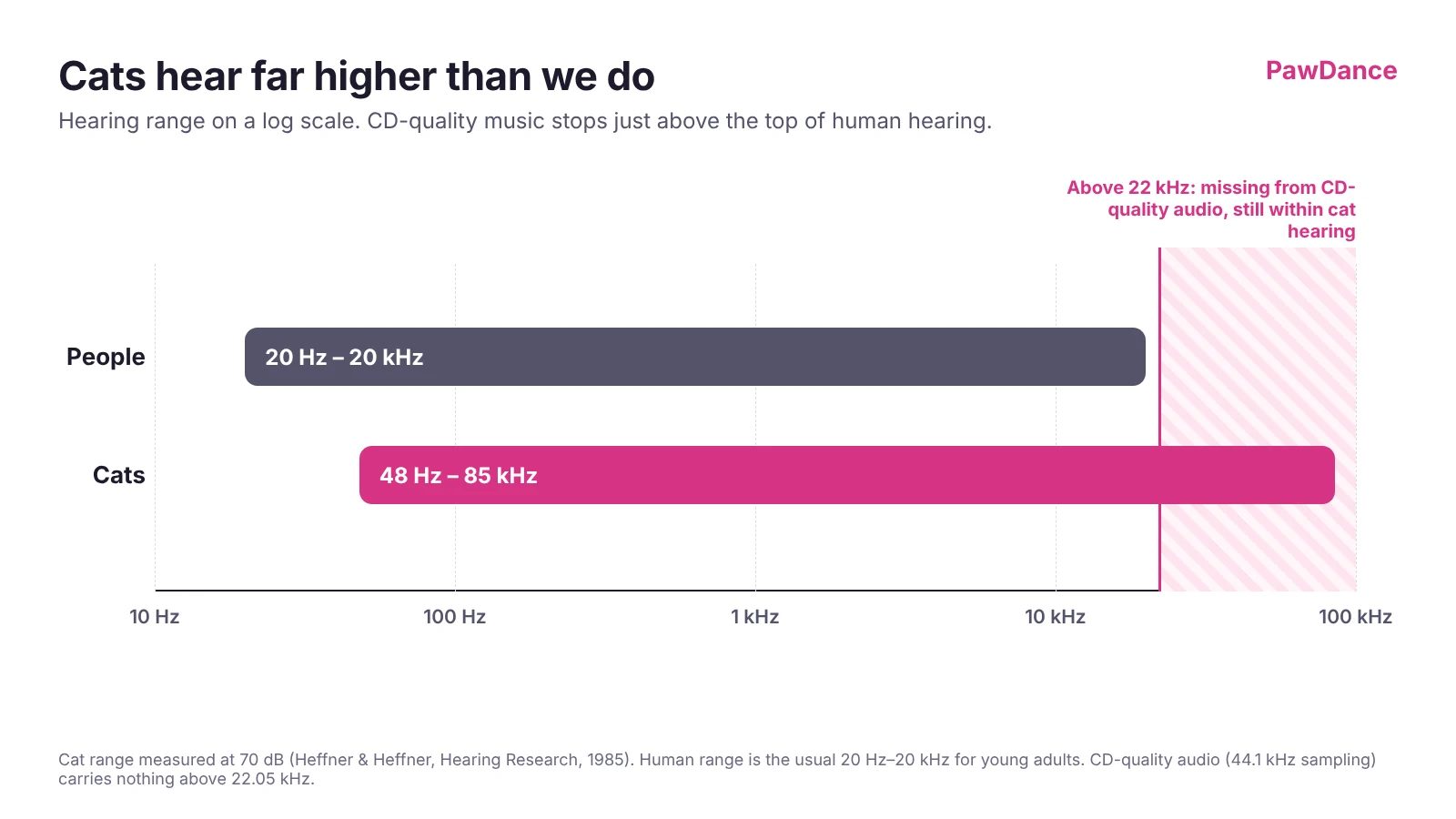
Cats also hear much higher than we do. In the classic measurement by Heffner and Heffner, cats heard from 48 Hz up to 85 kHz at 70 dB; people top out around 20 kHz (more on cat hearing in Acoustics Today). CD-quality audio stops at 22.05 kHz, so the top end of what a cat could hear is simply not in your recording. What is in there tends to be bass and drums, which cats don’t use to talk to each other.
What music do cats like?
Going by the studies, here is what to try, in order. Treat it as a starting list: individual cats differ, and some cats like none of it.
| Sound | What the studies found | Try it when |
|---|---|---|
| Music made for cats | Quicker positive responses at home; lower stress at the vet | Before a vet trip, a car ride, or visitors |
| Quiet classical | Calmest of three genres under anaesthesia; ignored at home; no better than silence at the vet | You want background music and your cat doesn’t object |
| Silence | As good as classical at the vet | Always a fine choice |
| Loud, bass-heavy music | Heavy metal gave the least calm readings under anaesthesia | Best kept for headphones |
A note on “cat music” and “music for cats” playlists online: most of them are not the tracks that were tested. Plenty are relaxing human music with a cat photo on top. They may be fine, but the studies above don’t tell you whether they work.
How to tell if your cat likes a song
You can run a small version of the 2015 study in your living room. It costs nothing and takes about ten minutes.
- Start with quiet. Pick a calm moment when your cat is awake and not hungry.
- Keep it low. No study set a volume, so start well below what you would play for yourself, with the speaker at floor height and away from your cat’s bed or litter tray.
- Leave the door open. Your cat should be able to walk away. Walking away is an answer too.
- Wait a few minutes. In the study, positive responses took about two minutes on average, so give each track at least five.
- Watch for the study’s signs. Good: purring, walking toward the speaker, rubbing against it, settling down to sleep nearby. Bad: hissing, an arched back, fur standing up, or leaving the room.
- Compare on different days: cat music one day, quiet classical another, silence a third.
If your cat rubs its face on the speaker, congratulations: in the researchers’ reading, the speaker now belongs to the cat.
Should you leave music on for your cat?
No study has tested music for a cat left home alone, so there is no evidence either way. If you do leave something on, the safer bet is cat music or quiet classical at low volume, in one room only, so your cat can go somewhere quieter. If your cat seems stressed when you’re out, talk to your vet about it.
Do cats dance to music?
Not in the sense of keeping time. When a Harvard researcher searched YouTube for animals moving to the beat, the ones that really kept time were all vocal mimics, such as parrots. Dogs and cats were in the sample and didn’t make the cut. A cat that seems to dance in a clip has been edited to the music, is reacting to something off-camera, or was made with AI.
That last group includes ours. We make AI pet dance videos from still photos, and we measured the songs in five of our cat videos: their tempos run from 112 to 152 beats per minute, set for human dancers. The cats are on the beat because the AI copies human dancers, and the cats themselves were photographed in silence. Going by the 2015 study, a real cat would rather have the 1,380-beat purr track.
If you want your cat “dancing” anyway, the Suave cat dance fits three cats and the NEON two cats dancing template fits two pets; our guide to AI cat dance videos covers the photos to use. They are paid ($8.99 a video, no subscription), and you can browse every dance on our pet dance templates page. Dog owners asking the same question will find the dog version of the beat research in our guide on teaching your dog to dance.
Frequently asked questions
Do cats like music?
Most cats show little interest in human music. In a 2015 study of 47 cats, they responded sooner and more positively to music composed for cats, pitched in their vocal range and paced like purring or suckling. Some cats settle to quiet background music; others prefer silence.
What music do cats like?
Music written for cats did best in studies: higher-pitched, with sliding notes and the pulse of purring or suckling. Among human music, quiet classical calmed cats under anaesthesia more than pop, and heavy metal least. Keep loud, bass-heavy music away from cats.
Do cats like classical music?
Not especially. Cats at home mostly ignored Bach and Fauré in a 2015 study, and at a vet clinic classical music did no better than silence. Under anaesthesia, though, cats breathed slower and had smaller pupils with classical than with pop or heavy metal.
Can cats hear music?
Yes, and a wider range than we can. Cats hear from about 48 Hz to 85 kHz at 70 dB, compared with roughly 20 Hz to 20 kHz for people. CD-quality recordings carry nothing above 22.05 kHz, so the highest sounds a cat can hear are not in your music at all.
Should I leave music on for my cat when I go out?
No study has tested it. If you want to, play cat music or quiet classical at low volume in one room, so your cat can move somewhere quieter. If your cat seems stressed when left alone, ask your vet.
Do cats like it when you sing to them?
No study has tested owners singing. Research suggests cats pay more attention to sounds in their own vocal range, about an octave or more above human voices, so a soft, higher voice is more likely to get a reaction. Purring and coming closer are good signs; walking off is a clear no.
Do cats dance to music?
Not to the beat. A Harvard researcher who searched YouTube for animals moving in time to music found real beat-keeping only in vocal mimics such as parrots; dogs and cats didn’t show it. Dancing cat videos are edited to the music, show cats reacting to something else, or are made with AI.
More guides
- How to make your dog dance with AI, from one photo to a finished video
- AI cat dance: how to get your cat dancing (even the one who hides from cameras)
- Christmas dancing dog (and cat) videos, made from one photo of each pet
- Viggle AI alternatives for pets: what happened when we gave Viggle a cat
- How to teach your dog to dance: five moves, one routine, no hind legs required
- Dog Christmas card ideas: 12 photos, a few good lines, and one card that moves
Or go straight to the AI dog dance and cat dance generator and pick a dance.