How to teach your dog to dance: five moves, one routine, no hind legs required
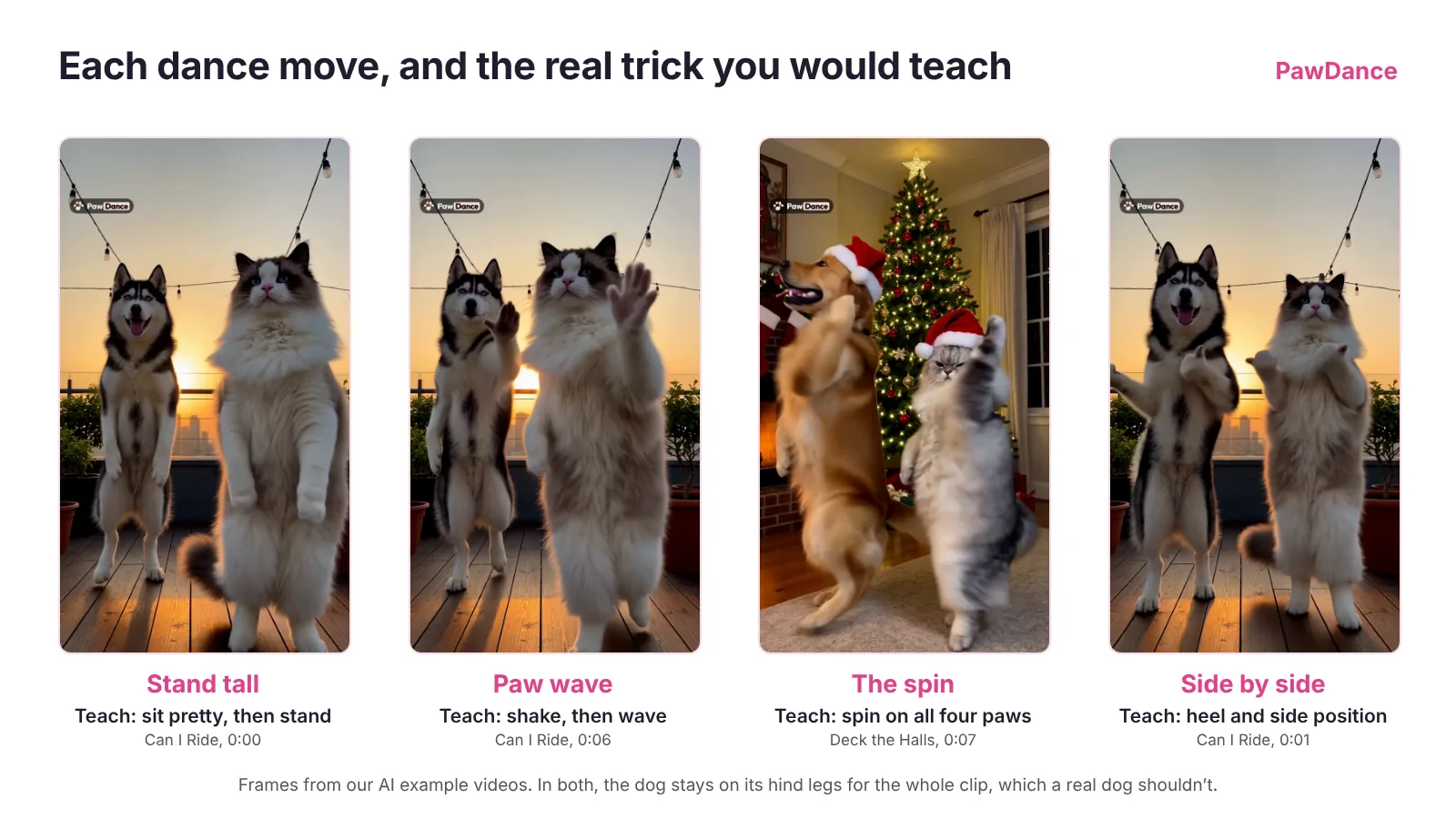
To teach your dog to dance, start with moves on all four paws: walking at your side, a spin each way, a bow and a paw wave. Teach each one with a treat lure and a reward, a few minutes at a time, then link three or four of them to a song you like. With short daily sessions, a first 30-second routine in about a month is a realistic goal.
That is the honest version of how to teach your dog to dance. The dog sport behind it is called musical canine freestyle, and the American Kennel Club’s guide to freestyle describes it the same way: a foundation of obedience and tricks, then moves chained together to music. Nobody starts with the Macarena.
A note on who is writing this. We make AI dog dance videos, so we spend a lot of time looking at dogs dancing in ways real dogs shouldn’t. The image at the top of this page shows frames from two of our own videos next to the trick you would actually teach for each move. This guide is about the real thing: the moves, which dogs should skip the hind-leg tricks, and a four-week plan to a first routine.
Can dogs really dance?
Not in the way people mean when they say someone has rhythm. In a 2009 study published in Current Biology, Harvard researchers searched YouTube for animals moving in time with music. The animals with convincing evidence of keeping a beat were all vocal mimics, mostly parrots like Snowball the cockatoo. Dogs were in the search, and none made the list.
So when a dog dances, the dog is doing tricks on cue and the person is doing the timing. That is good news for you: you don’t need a dog with rhythm, only a dog who likes treats and a handler who can count to four. It is also why dog freestyle dancing looks so different from dog to dog. A routine is built from whatever that dog does well.
Before you start: is your dog built for it?
Every move in the main plan below keeps all four paws on the ground, and most healthy dogs can learn them. The tricks that put a dog on its hind legs are different. Sitting up and standing load the back and hind joints, and they are not for every dog.
- Long-backed, short-legged breeds. The AKC’s page on intervertebral disk disease names Dachshunds, Pembroke Welsh Corgis and Basset Hounds as breeds at higher risk, and lists jumping and hard landings among the causes. Keep these dogs on four paws.
- Top-heavy dogs. PetMD notes that moves like extended rear-leg walking might be uncomfortable for top-heavy breeds.
- Puppies, older dogs and any dog with joint or back trouble. Ask your vet before teaching anything that lifts the front paws off the ground, and stop if your dog seems stiff or reluctant afterwards.
Practise on a rug, a yoga mat or grass. A spin on a slippery kitchen floor is how a dance class turns into a vet visit.
What you need
- Small, soft treats you can hand over fast. You will use dozens per session, so keep them tiny.
- A marker: a clicker or one short word like “yes” that means a treat is coming. PetMD calls clicker training a great option for dance moves because it marks the exact moment your dog gets it right.
- Short sessions: 5 to 10 minutes, two or three times a day. End while your dog still wants more.
- A song you can stand hearing 200 times. You will.
The five beginner moves, step by step
Teach these in order. Each one builds on the one before, and together they make a routine. For every move, the pattern is the same: lure the position with a treat, mark and reward the moment it happens, repeat until it’s easy, then turn the lure into a hand signal and add a word.
1. Heel and side: the base of every routine
- Stand with your dog on your left. Hold a treat at your left hip.
- Take one step. If your dog stays at your side, mark and reward. Build up to 10 steps.
- Add the word “heel” as you start walking.
- Repeat with your dog on your right side and call that one “side”.
It looks like the least exciting move, but it is the glue of every routine. According to the AKC, freestyle has its roots in obedience, with early trainers setting heeling to music, and heelwork to music is still a related style of its own, where the dog works close to the handler.
2. Spin and twirl
The spin is the easiest dance move to teach a dog, and the one that makes it look like dancing.
- Hold a treat at your dog’s nose and move it slowly in a wide circle at head height.
- Reward when your dog completes the full turn. If they give up halfway, make the circle bigger and slower.
- After a few good turns, do the same motion with an empty hand and reward from the other hand.
- Shrink the motion to a small circle of your finger and add the word “spin”.
- Teach the other direction separately and give it its own word, like “twirl”.
That is all there is to how to teach a dog to spin. Two directions with two names is what lets you build patterns later: spin, twirl, spin.
3. Bow
- With your dog standing, hold a treat at their nose and move it slowly down and back toward their chest.
- Mark the moment the elbows touch the ground while the back end stays up. That is a bow, the classic finish.
- If your dog lies down completely, mark earlier, as the front end starts to drop.
- Add the word “bow” once your dog dips readily on the lure.
4. Paw wave
- Start from “shake”: hold out your hand and reward when your dog puts a paw in it.
- Raise your hand a little higher each time, so your dog reaches up for it.
- Pull your hand away just before the paw lands, and mark the paw in the air.
- Turn it into a wave signal, a small wave of your own hand, and add “wave”.
5. Weave through your legs
- Stand with your feet wide apart and your dog on your left.
- Step forward with your right foot and lure your dog through the gap from left to right with a treat.
- Step with your left foot and lure them back through the other way.
- Once your dog follows the hand, go slower and add the word “weave”.
Optional: sit pretty. Only for dogs your vet is happy with. From a sit, raise a treat slowly above your dog’s head until both front paws lift, reward, and keep the holds short. This is the move AI videos get most wrong: in the frames above, the dogs stay on their hind legs for the whole clip.
Put it together: your first routine
Linking moves into a sequence is what the AKC calls chaining, and it is the step that turns tricks into a dance. Start with two moves in a row and one reward at the end, then three, then four. Leave the music off until the sequence is smooth, then add it back.
For the music, the AKC suggests picking a song that suits your dog’s size and way of moving. A steady, mid-tempo beat helps both of you, because you will move to the beat and your dog will follow you. Here is a 30-second beginner routine built only from the five moves:
| Time | Move | What you do |
|---|---|---|
| 0:00–0:08 | Heel | Walk forward eight steps with your dog on your left |
| 0:08–0:12 | Spin, twirl | Stop, signal a spin, then a twirl |
| 0:12–0:20 | Side | Turn and walk back with your dog on your right |
| 0:20–0:24 | Weave | Two steps forward with your dog weaving through your legs |
| 0:24–0:27 | Wave | Stop, face your dog, and cue a wave |
| 0:27–0:30 | Bow | Finish on a bow, then the jackpot treat |
A four-week plan from zero to a routine
This is a sample schedule for dog dancing training at home, at 5 to 10 minutes a session. Some dogs move faster, some need two weeks on the spin, and both are fine. Move on when a step works about 8 times out of 10.
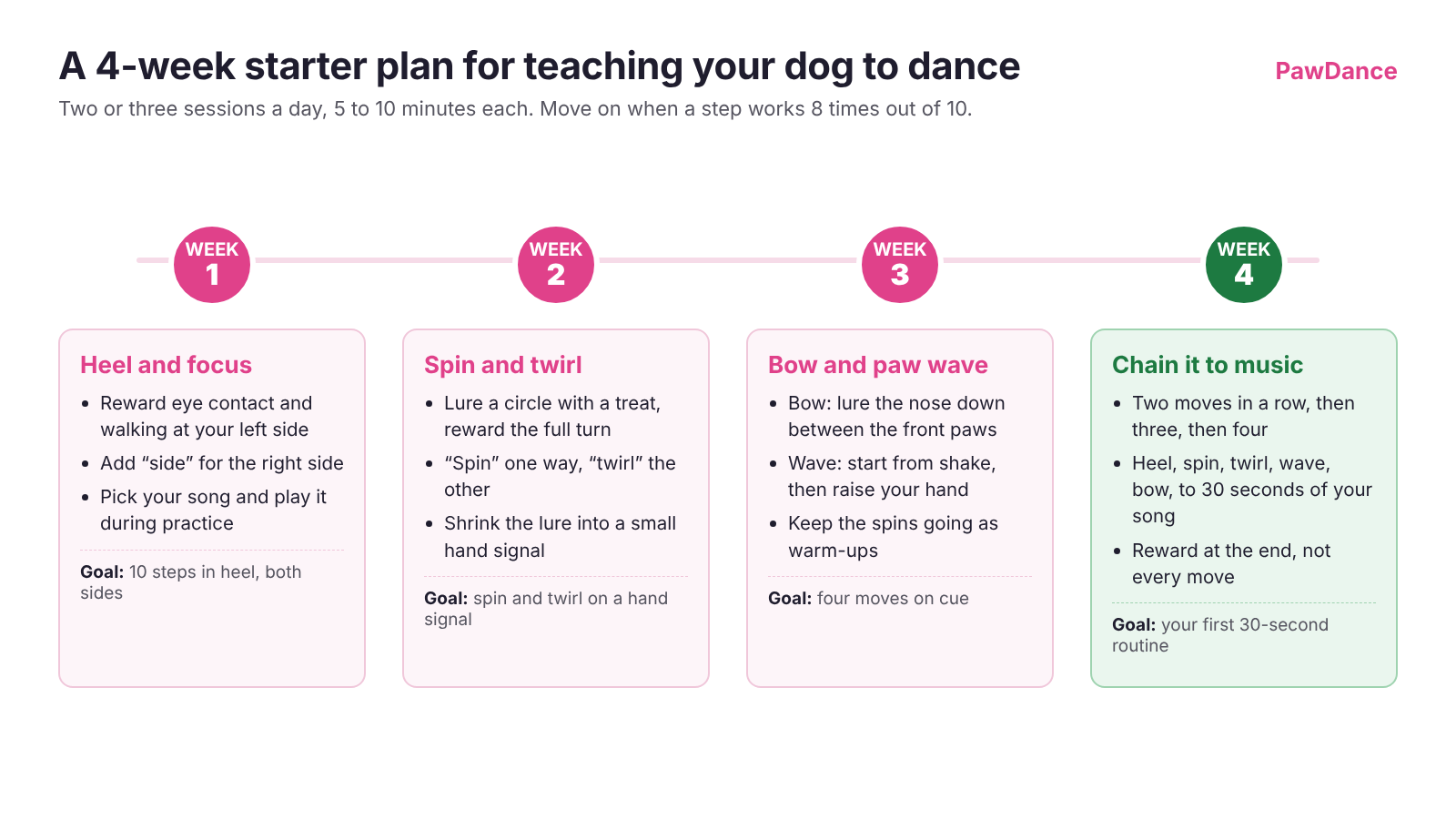
- Week 1, heel and focus: reward eye contact and walking at your left side, add “side” for the right, and start playing your song during practice. Goal: 10 steps in heel on both sides.
- Week 2, spin and twirl: lure a full circle with a treat, give each direction its own word, then shrink the lure into a hand signal.
- Week 3, bow and paw wave: lure the nose down between the front paws for the bow, and build the wave from shake. Goal: four moves on cue.
- Week 4, chain it to music: two moves in a row, then three, then four, ending in your first 30-second routine with one reward at the end.
Why rewards, not corrections
Every step above uses treats and praise, and there is good evidence for keeping it that way. A 2020 study in PLOS ONE followed 92 companion dogs from reward-based and aversive-based training schools. The dogs trained with aversive methods showed more stress behaviours during training and higher cortisol afterwards, and the authors concluded that those methods, especially in high proportions, compromise dog welfare. A dance is supposed to be fun for both of you, so if your dog checks out, end the session and try again later.
When it isn’t working
| Problem | Likely cause | Fix |
|---|---|---|
| Your dog follows the treat halfway, then quits | The circle is too small or too fast | Make the lure circle wider and slower, and reward half turns at first |
| Your dog only spins with a treat in your hand | The lure stayed in too long | Lure three times, then use an empty hand and reward from the other hand |
| Every cue gets the same move | The signals look too alike | Make each hand signal clearly different, and practise one move per session for a while |
| The routine falls apart with music on | The music is new and exciting | Play the song in the background during everyday training before you dance to it |
| Your dog lies down instead of bowing | The mark comes too late | Mark as the front end starts to drop, before the back end follows |
Want the video before the training is done?
Real canine freestyle takes months to polish, and that is half the fun. If you want a dancing-dog video for a birthday or a holiday card this week, an AI video gets you the look without asking anything of your dog. That is what we make: you add a photo of your dog, pick a dance, and get a video of your dog doing it to the original music. Our guide to making your dog dance with AI walks through the photo and the dance choice, and the pet dance templates include the Can I Ride duo dance and the Deck the Halls Christmas dance shown at the top.
Just remember the difference. In both of those videos the dog stays upright for every frame we checked, from start to finish. Your real dog only needs to hold a bow for a second, and gets a treat for it.
Frequently asked questions
Can dogs really dance?
Not to a beat the way people do. A 2009 Harvard study of YouTube videos found convincing beat-keeping only in vocal mimics, mostly parrots, and dogs were not among them. A dancing dog is doing tricks on cue while the handler keeps time to the music.
What is dog dancing called?
Musical canine freestyle, often just called dog dancing: a dog and handler perform a routine set to music, built from obedience and trick training. Heelwork to music is a related style where the dog works close to the handler in heel positions.
How long does it take to teach a dog to dance?
A single move like the spin often comes together within a few short sessions. With 5 to 10 minutes of practice two or three times a day, a first 30-second routine of four or five moves is a realistic goal for about a month. Polished competition routines take far longer.
What is the easiest dance move to teach a dog?
The spin. You move a treat in a slow circle at your dog’s head height and reward the full turn, then fade the treat into a small circle of your finger. Teach the other direction as a separate move, such as “twirl”.
Is it bad for dogs to stand on their hind legs?
It puts weight on the back and hind joints, so ask your vet first. Keep long-backed breeds at higher risk of disk disease, such as Dachshunds, Corgis and Basset Hounds, on four paws, along with puppies, older dogs and dogs with joint problems, and keep any holds short.
Can any dog learn to dance?
Most dogs can learn the four-paw moves: heel, spin, bow, wave and weave. A routine is built from what your dog does well, so a small, older or less athletic dog can still dance with simpler moves and a slower song.
More guides
- How to make your dog dance with AI, from one photo to a finished video
- AI cat dance: how to get your cat dancing (even the one who hides from cameras)
- Christmas dancing dog (and cat) videos, made from one photo of each pet
- Viggle AI alternatives for pets: what happened when we gave Viggle a cat
- Dog Christmas card ideas: 12 photos, a few good lines, and one card that moves
- Do cats like music? What the research found, and what to play for yours
Or go straight to the AI dog dance and cat dance generator and pick a dance.